
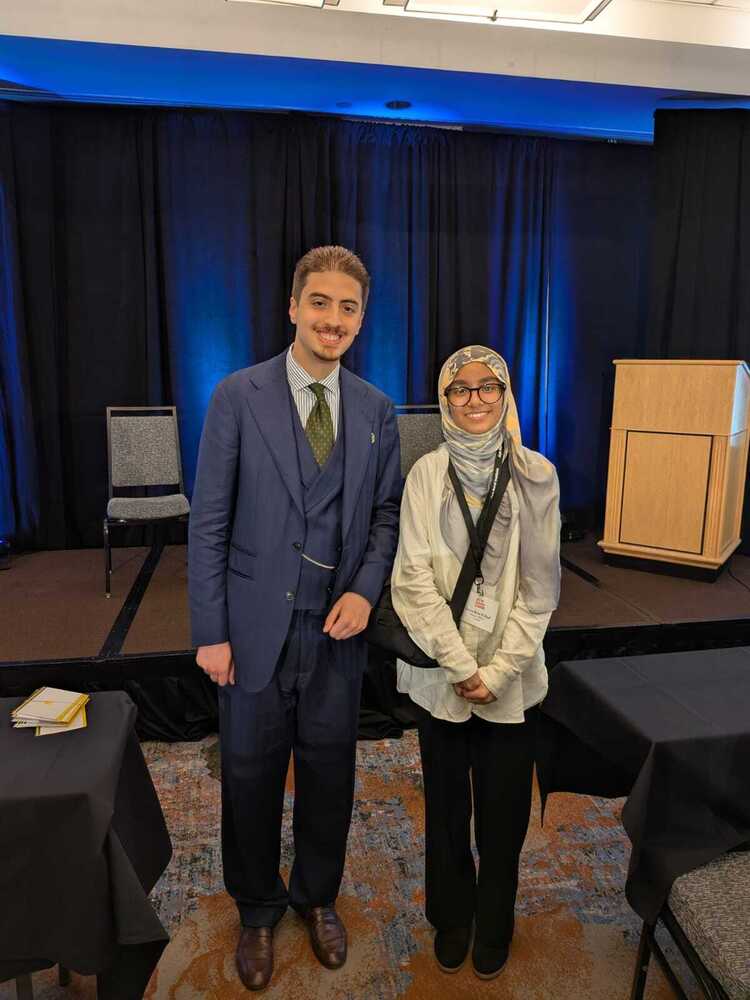
From Bassano to Austin: Fatima Binat-E-Wasif’s Essays Take Her to an International Conference
Most Grade 9 reading assignments end with an essay, a mark, and a return to the shelf. Fatima Binat-E-Wasif’s ended in Austin, Texas.
Last year, Fatima read Anthem, Ayn Rand’s short dystopian novel about a society that has stamped out individuality so completely that the word “I” is forbidden. People speak only as “we.” Independent thought is a crime, and the one person who keeps a private self is breaking the law just by doing it.
It’s a book that invites big questions, and Fatima took it seriously. She entered the Ayn Rand Institute’s Anthem Essay Contest, an international competition for students in Grades 8 to 12. It isn’t a book report contest. Judges look at whether a student can build an argument and defend it with evidence from the text. They don’t care whether the student agrees with Rand. They care whether the student can make a clear case and back it up.
Fatima wrote three analytical essays. One examined the Saint of the Pyre, a figure in the novel who is executed for speaking the forbidden word and who goes to his death defiant rather than broken. Another looked at the link between language and thought, and what happens to a person’s ability to think for themselves when the words for it are taken away. Neither topic gets far on plot summary. Both require close reading and a clear position.
The essays caught the attention of ARI staff, who followed up with an interview about her work and her understanding of the novel. That conversation led to a personal invitation to attend AynRandCon USA, held September 11–13, 2026, in Austin.
AynRandCon is an annual conference that brings students together with scholars and ARI staff for several days of talks and discussion on individual freedom and Rand’s philosophy. Speakers take questions during sessions and make themselves available between them, so attendees aren’t just an audience. Fatima spent the weekend in presentations and conversations with students from across North America and beyond. She also met people who think about these questions for a living.
Put it together and a Grade 9 student from a K–12 school of about 200 students in rural Alberta read a book, argued with it on paper, and ended up in a room full of people doing the same thing at a much higher level. That’s worth noticing.
It’s also a good reminder of what reading can do when a student decides to take it all the way. Fatima didn’t wait for an assignment to tell her how far to go with Anthem. She went as far as the book would take her, and then a bit further.
Congratulations, Fatima. We’re proud of you, and we’re looking forward to seeing where your next argument takes you.